
Providing large area deposition systems for LCD and OLED displays.

Display Technology
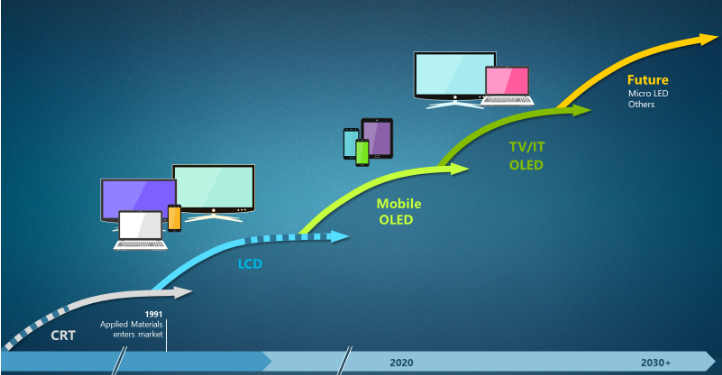
In the early 1990s, the modern display industry emerged with the adoption of LCD technology in laptop computers. LCDs provided a thin form factor and a portability that was impossible with the incumbent CRT technology. Over the next 20 years, LCDs diffused beyond laptops and niche devices to dominate the display landscape, displacing CRT in TVs and monitors and enabling new devices such as smartphones. We are now at the start of the next technology replacement wave as OLED displays are emerging to replace LCDs in consumer devices. There are other interesting technologies forthcoming, including mini-LEDs, micro-LEDs and micro-OLEDs. While these names sound similar and are easy to confuse, these are very distinct technologies with different strengths, challenges, applications and time horizons.
With their brilliant image quality—high contrast ratio and wide color range—and dynamic form factors including flexible and foldable, OLEDs are already seeing wide adoption in smartphones (~40% penetration this year and increasing fast). Adoption in large-area devices like laptops, tablets and monitors will also grow over the next few years.
This “OLED wave” is transforming the display industry. Already today, all new smartphone fabs are OLED lines, and we will soon see large-area fab investments in OLED. This is good news for companies likeZapnix Semiconductor because the equipment capex per fab is significantly higher for OLED than for LCDs.
Mini-LED is an LCD enhancement technology and part of the ongoing effort by LCD makers to narrow the performance gap between LCD and OLED. Mini-LED LCDs employ arrays of very small LEDs (100-1,000 micron size range) in the backlight, behind the LCD panel, to provide more control of pixel illumination (see Figure 2). Mini-LED backlights provide better dark/light contrast versus traditional LCDs by taking advantage of local dimming of multiple zones; this partially narrows the contrast performance gap relative to OLEDs.
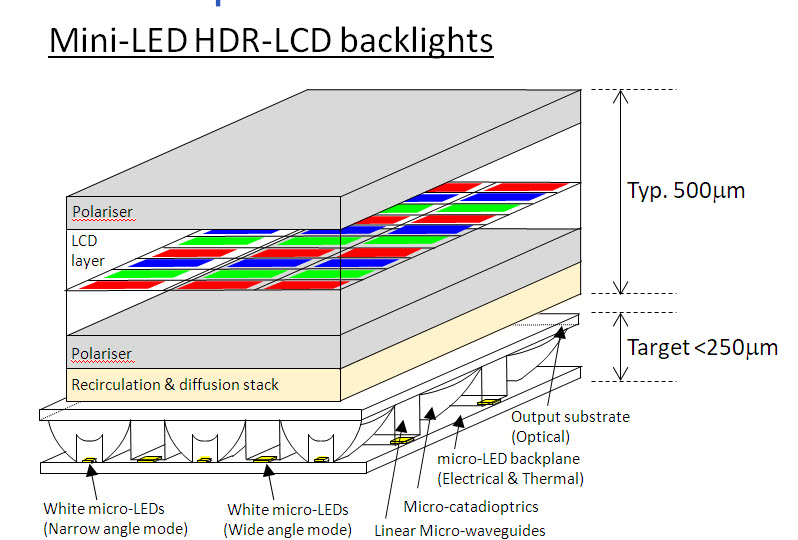
The challenge with Mini-LED technology comes down to a cost/benefit tradeoff. To get anywhere close to the contrast ratio of OLED, mini-LED LCDs need more than 10,000 individual chips and an active matrix backplane to drive a high-performance backlight. This backlight backplane is needed in addition to the primary backplane already used to drive the LCD pixels. The result is a display that looks better than traditional LCD but not as good as OLED—with a cost that’s at least as high as OLED today. Mini-LED LCDs retain the other deficits versus OLED—a lower color range, slower response times and a thicker form factor.
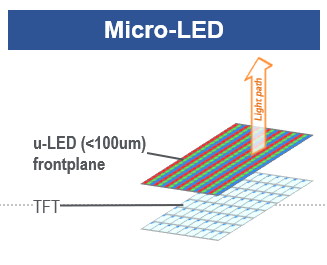
Whereas mini-LED is just an LCD backlight enhancement, micro-LED is a self-emitting display technology (like OLED) using LEDs less than 50-100 microns in size, each becoming an individual red, green or blue sub-pixel (see Figure 3). Micro-LED technology matches or exceeds OLED and LCD in almost every performance area. It has the image quality and form factor benefits of OLED without the robustness and lifetime issues. It exceeds LCD and OLED in terms of brightness and also has lower power consumption. Micro-LED is indeed the “holy grail” of displays..
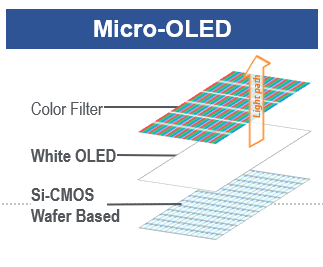
Micro-OLED is another interesting technology emerging in displays. It enables very high resolution (greater than 1,000 pixels per inch) and can be used in near-eye applications like virtual and augmented reality (VR/AR). Micro-OLED can be manufactured with a frontplane similar to the White OLED (WOLED) technology used in TVs today (blanket OLED layers are evaporated onto a substrate to emit white color; then a color filter renders the light red, green or blue). But to enable the high resolution and small pixels, the backplane is built on silicon wafers using semiconductor manufacturing technology (see Figure 4). Micro-OLED is a viable technology, but its application is expected to be limited to small, near-eye or projected displays, and we do not expect it to challenge conventional OLED for mainstream applications.

Copyrights 2024©, zapnix. All Rights Reserved.